
2025年11月28日至29日,第十届网络社会年会新加坡场作为 新加坡管理大学(SMU)Web3Week(11月27日至30日)的特别策划活动,在新加坡管理大学(SMU)义安公司礼堂(The Ngee Ann Kongsi Auditorium)举办。本届年会新加坡场由新加坡管理大学计算与信息系统学院主办,中国美术学院跨媒体艺术学院、网络社会研究所及开放媒体系协办,由朱飞达教授与黄孙权教授共同担任会议总召。
继上海场年会以“互联的终结?爱(AI)来不来?”为题之后,新加坡场将目光投向那个被宣告存在于互联网终结之后的世界,以“将临的网络:互为劳动与社会的重组”(The Network to Come: Inter-Labor and the Recomposition of the Social)为主题,汇集理论家、艺术家与技术研究者,从不可见劳动的经济学到算法的诗学,从云基础设施的地缘政治到共享能动性的艺术实践,共同探索这一转型。
11月28日会议开幕期间,朱飞达教授、黄孙权教授分别为会议开幕致辞。文稿整理自现场录音。
朱飞达教授致辞
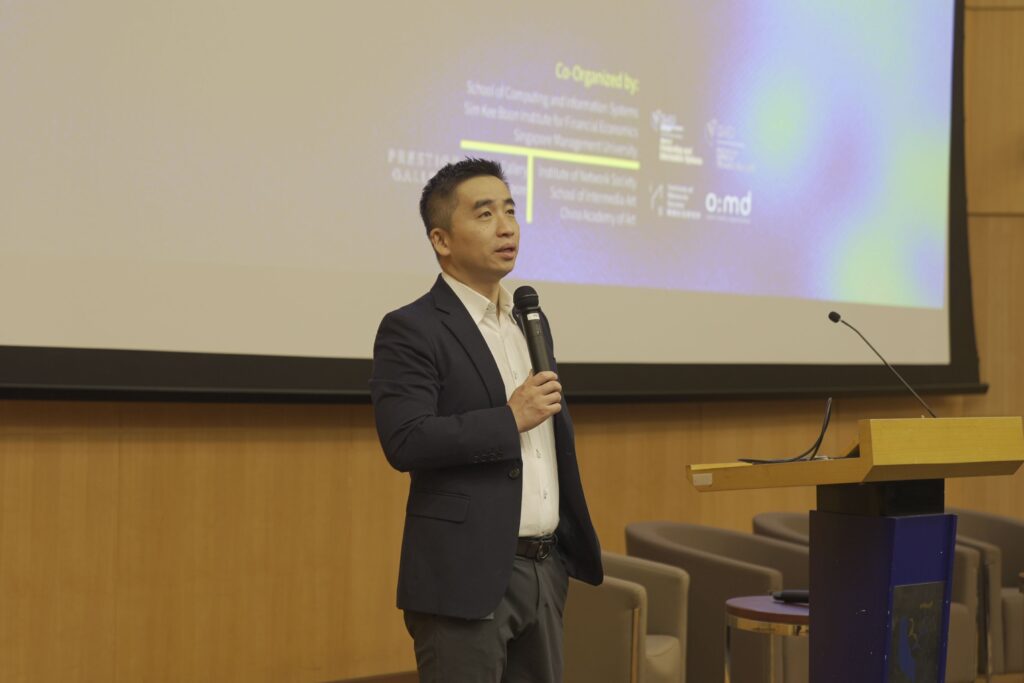
好,我想我们可以开始了。大家早上好。欢迎来到SMU Web3周的第二天。
如果你昨天也在这里,就会知道我们安排了满满的Web3主题。上午的的内容主要关注DeFi,包括加密货币交易的宏观和微观结构、模型等等。下午则探索了更多领域。我们聚焦于Web3如何革新媒体行业、创意经济、深化绿色金融、RWA以及人工智能与Web3的结合。
今天,我们将更加冒险性地探索人工智能和Web3技术与文化艺术等领域的联系。我们非常荣幸地邀请到众多来自业界和学术界的知名艺术家和研究人员与我们共聚一堂。
我谨代表新加坡管理大学欢迎各位的到来。首先,我要感谢所有支持者。本次Web3周活动由Aptos基金会赞助。
我们还要感谢钻石赞助商Yield Royal Investment,黄金赞助商Cleanverse、exSat和MeTag,以及白银赞助商VC Plus。
没有他们的帮助,这一切都无法实现。正如我所说,今天我们将聚焦一个跨学科领域。我们将人工智能和Web3与文化、社会、哲学乃至艺术等各个方面融合在一起。
我还要欢迎我们的联合召集人,来自中国美术学院的黄孙权教授上台发言。
Okay, I think we can get started. Good morning, everyone. So, welcome to the second day of our SMU Web3 week.
If you were here yesterday, you would know that we actually have a quite full day of all the Web3 topics, right? Covering the morning session, we were looking at the DeFi, right? The macro and the microstructure of the crypto trading, the model, this stuff. All the way to, in the afternoon, we explore a variety of horizons. We will look at Web3 revolutionizing the media industry, creative economy, deepening green finance, RWA, as well as AI and Web3.
Now, today, we are even more adventurous. We’re going to explore AI and Web3 in connection to culture and art and this sort of stuff. And we are very honored to have a list of very renowned and established artists, researchers from both industry and academia to be with us today.
It is my pleasure to welcome everyone to Singapore Management University. And, as always, I’d like to start by thanking our supporters. This whole Web3 week is supported by Aptos Foundation.
And we also thank our Diamond sponsor, Yield Royal Investment. Our Gold sponsor, Cleanverse, exSat, and MeTag. And then our Silver sponsor, VC Plus.
Without their help, it is not possible to make this happen. So, as I said, today, we are looking at a very interdisciplinary area. We are AI and Web3, merged together with all the topics in culture, society, philosophy, or even art.
And I’d like to welcome our co-advisor, Professor HUANG Sun-Chuan from China Academy of Art to come up on stage and say something.
黄孙权教授致辞
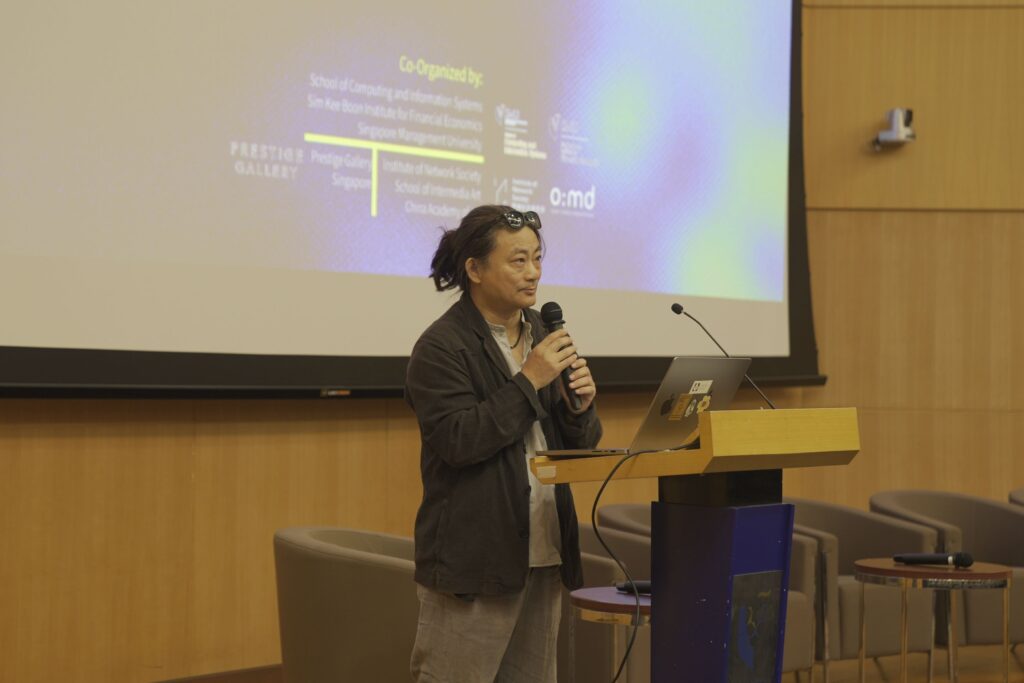
各位早上好。首先,我要向新加坡管理大学表达我最深切的感谢。
在此特别感谢朱飞达教授。正是由于他的远见和支持,中国美术学院网络社会研究所才能将第十届年会特别版带到新加坡,并让我们有机会参与到Web3周活动正在进行的这场意义深远的讨论中。
最近,我们在上海举办了第十届年会,主题为“互联网的终结:人工智能的到来与否”。我们探讨了互联网如何从开放的象征演变为私有化的平台。
但今天,感谢新加坡管理大学(SMU),我们得以翻开新的一页。我们将“终结”的概念转向“永不到来”。我们在此提出一个关于“互为劳动”的全新理论探索之旅。
我们认为,人工智能并非外来的发明,而是人类集体历史的一种构想。当我们与人工智能互动时,我们不仅仅是与机器共存,而是进入了一个事件生态,在这个生态中,我们通过算法的媒介彼此协作。
这就是互为劳动。在这种状态下,作者身份、价值和关怀的界限变得模糊,社会结构也在悄然重构。
在接下来的两天里,我们将深入探讨这一转变。今天,我们邀请了众多理论家和艺术家,共同剖析隐形劳动的目标以及算法的政治意义。明天上午,我们将举办一场特别的活动。
首先,我们将放映迪伦的电影《互联网的终结》。这部电影与我们上海主题的批判精神不谋而合,它以视觉化的方式展现了旧互联网的崩溃,为我们理解为何需要新的网络提供了至关重要的背景。
放映结束后,我们诚邀您参加由我和中国美术学院开放媒体系共同策划的展览“共享的错误”的开幕式。
他们的艺术不仅具有装饰作用,更是一种展现新世界瞬息万变的机遇与挑战的方式。感谢各位与我们一同探讨如何批判新世界的劳动。祝愿我们都能收获一场富有启发性的交流。
谢谢。
Good morning, everyone. First and foremost, I would like to express my deepest gratitude to Singapore Management University.
A very special thanks goes to Professor Zhu Fei Da. It is largely thanks to his vision and support that the Institute of Network Society in the Academy of Arts is able to bring our 10th annual conference special edition here to Singapore. And allowing us to participate in the emerging and meaningful discussion happening right now during the Web3 week.
Recently, in Shanghai, our 10th annual conference was held under the theme: “the end of the Internet. AI coming or not”. We discussed how the Internet was a metaphor for openness, and has solidified into the privatized platforms.
But today, thanks to the SMU, we are able to turn the page. We move the sense of the end to the never to come. We are here to propose a new theoretical journey on the theme “inter-labor”.
We argue that AI is not an alien invention, but a conception of the collective human history. When we interact with AI, we are not merely coexisting with machines. We are entering an event ecology where we work with one another through the mediation of the algorithm.
This is inter-labor. A condition where the boundary of authorship, value and care are blurred. And where the social is quietly being recomposed.
Over the next two days, we will explore this transformation. Today, we bring a lot of theorists and artists to dissect the target of invisible labor and the politics of the algorithm. Tomorrow morning, we have a very special program.
We will begin with a screening of Dylan’s film, The End of the Internet. The film shares the critical spirit of our Shanghai theme and visualizes the explosion of the old web, providing the very essential context for why we need a new network.
Following the screening, we invite you to the opening of our exhibition, “Shared Errors”, curated by me and the Department of Open Media of the China Academy of Art.
Their art serves not only decoration, but is a method to render visible the flashing delays and possibilities of the new world. I thank you all for joining us to explore how we might decry the labor of the new world. I wish us all an inspiring session.
Thank you.
讲者简介
朱飞达,现任新加坡管理大学计算与信息系统学院副院长、Aptos Move 讲席教授,并兼任新加坡科技研究局 A*Star 高级首席科学家、新加坡区块链协会董事兼教育资证委员会主席、复旦大学新加坡校友会会长。他是LEE Kiong Chian 基金会与DS LEE 基金会学者,创立并领导中国平安-SMU 大数据联合实验室及星展银行-SMU 智能分析联合实验室,亦为中国计算机学会大数据专委会委员。其研究领域涵盖人工智能与机器学习技术及治理、Web3 与可持续数智经济、数据资产与数据要素、区块链与分布式账本技术、社交网络及新媒体数据挖掘分析、数据驱动的商业智能与创新研究。
黄孙权,台湾大学工学博士,兼具艺术家、学者与策展人三重身份。现任中国美术学院跨媒体艺术学院特聘教授,并任网络社会研究所(INS)所长;长期耕耘于网络社会理论、合作经济与社会性艺术的交界面,亦曾在港台多所大学任教。1994年创办台湾另类青年文化刊物《破报》,出任总编辑,其媒体实践与公共介入相表里,塑造其跨域的方法论与写作语气。